
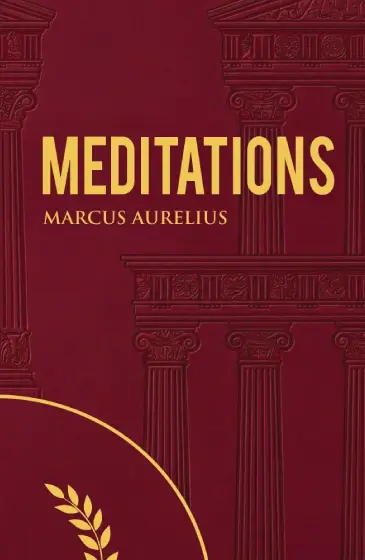
Meditations front
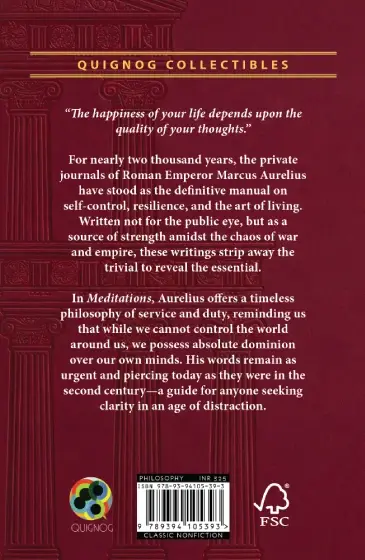
Meditations Back
“The happiness of your life depends upon the quality of your thoughts.”
For nearly two thousand years, the private journals of Roman Emperor Marcus Aurelius have stood as the definitive manual on self-control, resilience, and the art of living. Written not for the public eye, but as a source of strength amidst the chaos of war and empire, these writings strip away the trivial to reveal the essential.
In Meditations, Aurelius offers a timeless philosophy of service and duty, reminding us that while we cannot control the world around us, we possess absolute dominion over our own minds. His words remain as urgent and piercing today as they were in the second century—a guide for anyone seeking clarity in an age of distraction.
For nearly two thousand years, the private journals of Roman Emperor Marcus Aurelius have stood as the definitive manual on self-control, resilience, and the art of living. Written not for the public eye, but as a source of strength amidst the chaos of war and empire, these writings strip away the trivial to reveal the essential.
In Meditations, Aurelius offers a timeless philosophy of service and duty, reminding us that while we cannot control the world around us, we possess absolute dominion over our own minds. His words remain as urgent and piercing today as they were in the second century—a guide for anyone seeking clarity in an age of distraction.
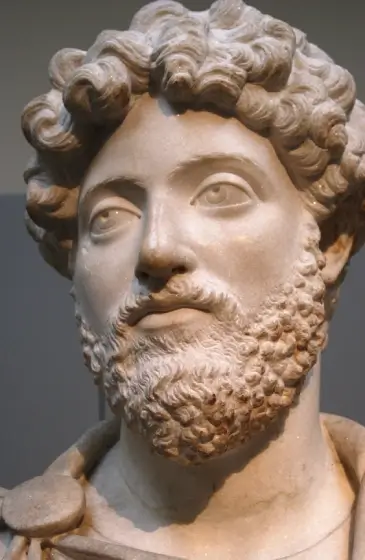
Marcus Aurelius Antoninus (A.D. 121–180) was a Roman Emperor and one of the most prominent philosophers of the Stoic tradition. Ascending to the throne in A.D. 161, his reign was fraught with severe trials, including devastating plagues, famines, and unrelenting wars against invading tribes on the empire's frontiers. Despite the absolute power he wielded and the heavy burdens of state, he remained deeply committed to justice, duty, and simplicity. His enduring literary legacy, the Meditations, was never intended for a public audience; rather, it is a private diary of his innermost reflections, often written in the quiet moments between battles in military camps. Today, these writings remain a timeless testament to a gentle, resilient mind striving to maintain its moral compass and live virtuously amid the chaos of the ancient world.