
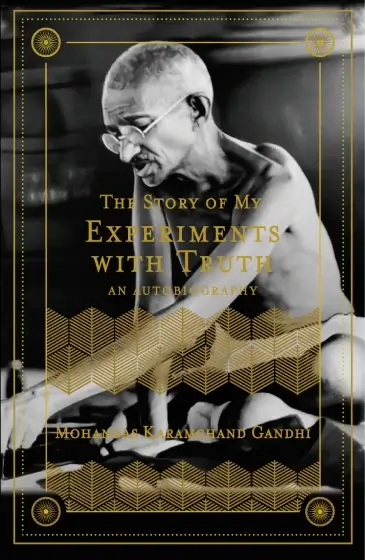
The Story of My Experiments with Truth

The Story of My Experiments with Truth
“Remember that all through history, there have been tyrants and murderers, and for a time, they seem invincible. But in the end, they always fall. Always.”
It has been seventy-five years since Mahatma Gandhi departed from our midst, but his life and soul continue to animate humanity transcending national and international boundaries. His contribution to human development is far too great and varied to have been forgotten or to be overlooked. The world today recognizes him as a far more compelling social innovator than humanity ever realized.
Written in the 1920s, Gandhi’s autobiography tells of his struggles and his inspirations; a powerful and enduring statement of an extraordinary life. In 1999, the book was designated as one of the "100 Best Spiritual Books of the 20th Century" by a committee of global spiritual and religious authorities.
Author: Mahatama Gandhi
It has been seventy-five years since Mahatma Gandhi departed from our midst, but his life and soul continue to animate humanity transcending national and international boundaries. His contribution to human development is far too great and varied to have been forgotten or to be overlooked. The world today recognizes him as a far more compelling social innovator than humanity ever realized.
Written in the 1920s, Gandhi’s autobiography tells of his struggles and his inspirations; a powerful and enduring statement of an extraordinary life. In 1999, the book was designated as one of the "100 Best Spiritual Books of the 20th Century" by a committee of global spiritual and religious authorities.
Author: Mahatama Gandhi

Mohandas Karamchand Gandhi (2 October 1869 – 30 January 1948) was the leader of the Indian independence movement in British-ruled India. Employing nonviolent civil disobedience, Gandhi led India to independence and inspired movements for civil rights and freedom across the world. The honorific Mahatma (Sanskrit: “high-souled”, “venerable”)—applied to him first in 1914 in South Africa—is now used worldwide. In India, he is also called Bapu (Gujarati: endearment for “father”) and Gandhiji. He is unofficially called the Father of the Nation.
Assuming leadership of the Indian National Congress in 1921, Gandhiji led nationwide campaigns for easing poverty, expanding women’s rights, building religious and ethnic amity, ending untouchability, but above all for achieving Swaraj or self-rule.
He attempted to practise nonviolence and truth in all situations, and advocated that others do the same. He lived modestly in a self-sufficient residential community and wore the traditional Indian dhoti and shawl, woven with yarn hand-spun on a charkha. He ate simple vegetarian food, and also undertook long fasts as a means of both self-purification and social protest. Mahatma Gandhi’s birthday, 2 October, is commemorated in India as Gandhi Jayanti, a national holiday, and worldwide as the International Day of Nonviolence.